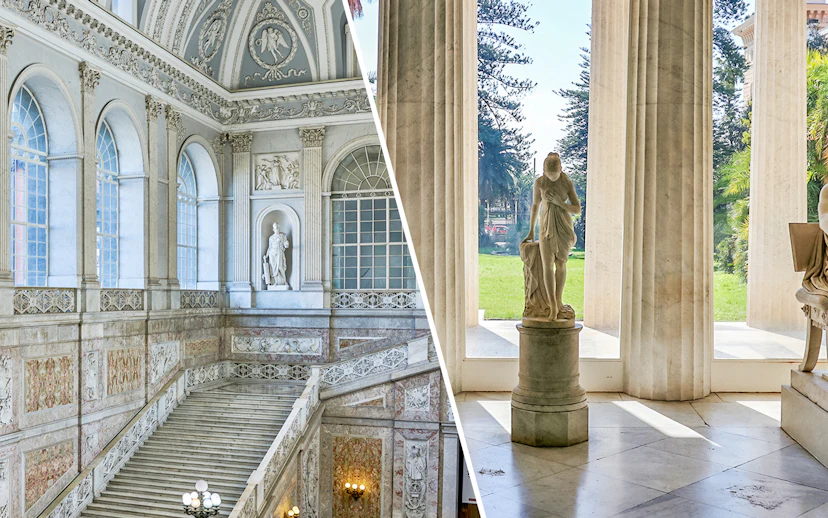
Villa Pignatelli is a neoclassical house museum best known for its preserved aristocratic rooms, quiet garden, and unusual carriage collection. The visit is compact and calm, but it rewards people who treat it as more than a quick photo stop, because the carriage pavilion is easy to miss if you leave after the main salons. Most visits take about an hour, a little longer if a temporary exhibition is on. This guide covers arrival, timing, route, and the Headout ticket options worth considering.
If you want the fast version before choosing your day and ticket, start here.
Villa Pignatelli sits on Riviera di Chiaia in Naples’s elegant seafront Chiaia neighborhood, about a 10-minute walk from Piazza Amedeo and easy to pair with the Lungomare.
Riviera di Chiaia 200, 80121 Naples, Italy
Villa Pignatelli is straightforward to enter, and the mistake most people make is assuming the whole visit ends with the main house. Start at the front entrance, then make sure you continue on to the garden and carriage pavilion before you leave.
When is it busiest? First Sundays, spring weekends, and mid-afternoon slots from April to July are the busiest, when the furnished rooms and carriage pavilion feel tighter than usual.
When should you actually go? Aim for a weekday visit between 9:30am and 11am, when you can move through the salons quietly before seafront foot traffic builds.
Monthly free-entry Sundays change the feel of Villa Pignatelli more than at bigger museums — the site is normally calm, so even a modest bump in visitors makes the small rooms feel busier.
| Visit type | Route | Duration | Walking distance | What you get |
|---|---|---|---|---|
Highlights only | Main salons → quick upstairs look → exit | 45–60 min | ~0.5 km | Covers the most important furnished rooms, but usually skips the garden pause and the carriage pavilion. |
Balanced visit | Main house → upstairs library and gallery → garden → carriage pavilion | 1–1.5 hrs | ~0.8 km | Gives you the full core visit without rushing and includes the section most visitors miss in the former stables. |
Full exploration | Main house → upstairs rooms → garden pause → carriage pavilion → temporary exhibition | 1.5–2 hrs | ~1 km | Adds time for photography, slower room-by-room viewing, and any temporary exhibition, but only if you do not treat the villa as a quick stop. |
You’ll want about 1–1.5 hours for a full visit. That gives you enough time for the main furnished rooms, the upstairs library and gallery areas, the garden, and the carriage pavilion without rushing. If there’s a temporary exhibition on, or if you like slow room-by-room photography, you could stretch it closer to 2 hours. Most people only feel rushed when they treat it as a 30-minute stop and skip the stables.
| Ticket type | What's included | Best for | Price range |
|---|---|---|---|
Combo (Save 5%): Royal Palace of Naples + Villa Pignatelli Skip-The-Line Tickets | Skip-the-line Royal Palace entry + access to temporary exhibitions + Villa Pignatelli skip-the-line entry + Museum of Carriages entry | A Naples museum day where you want two strong historic-interiors visits without handling separate bookings. | |
Artecard Napoli: 3 Museums Pass | Free entry to first 3 sites + up to 50% off more sites + 3 days of public transport + tourist assistance | A flexible city stay where you want Villa Pignatelli plus 2 other Naples sights with transport built in. | |
Combo (Save 5%): Naples National Archaeological Museum + Villa Pignatelli Tickets | Naples National Archaeological Museum entry + Villa Pignatelli skip-the-line entry + Museum of Carriages entry | A same-day plan that balances a large artifact-heavy museum with a shorter, quieter house museum. | |
Artecard Campania: 2 Museums Pass | Free entry to first 2 sites + up to 50% off more sites + 3-day validity + unlimited Unicocampania travel + tourist assistance | A wider Campania itinerary where Naples is only one stop and you want museum access plus regional transport. |
Villa Pignatelli is compact, but the route is split between the main house, the garden, and the carriage pavilion, so it’s easier to miss a whole section than you might expect. It’s easy enough to self-navigate, but the short layout and light wayfinding mean a quick orientation helps.
Suggested route: Start in the main house, go upstairs before taking a garden break, then finish at the carriage pavilion so you don’t accidentally leave after the salons.
💡 Pro tip: Screenshot the route in your head before you start — main house first, garden second, carriages last — because most people only miss one thing here, and it’s usually the stables.


Attribute — Room type: Formal reception salon
The Red Salon is the villa’s showpiece room, with deep crimson walls, decorative stucco, and period furnishings arranged to project status without feeling staged. It’s the space that most clearly sells the villa as a lived aristocratic home rather than a generic museum. What many visitors rush past is how intact the room arrangement feels — the furniture placement matters as much as the decoration.
Where to find it: Inside the main house on the principal reception route, shortly after the entrance sequence.
Attribute — Collection type: Family library and music archive
The library gives the house real personality, because it shows what the last owners collected and listened to rather than just what they displayed. Alongside books, you’ll find a substantial archive of classical and opera records that makes the room feel unusually personal for a historic house. Many visitors glance at the shelves and move on without noticing how central music was to the villa’s identity.
Where to find it: In the upper-floor rooms of the main house.
Attribute — Artwork type: Bronze sculpture
This bronze by Vincenzo Gemito is one of the villa’s standout art objects and one of the clearest reminders that Villa Pignatelli is also a collecting house, not just a preserved residence. It rewards a slower look, especially because smaller decorative objects around it can distract first-time visitors. What gets missed most often is how naturally it sits within the room rather than being isolated as a museum trophy.
Where to find it: Within the villa’s furnished interior rooms among the house collections.
Attribute — Collection type: Historic transport collection
The carriage pavilion is the most distinctive part of the visit because it adds an entirely different layer to the house story. You’ll see 19th-century coaches, buggies, and riding equipment that make aristocratic life feel practical as well as decorative. Many people assume the visit ends with the interiors and never reach the stables, which is why this section feels like a discovery even though it’s part of the same ticket.
Where to find it: In the former stables beyond the garden, separate from the main house.
Attribute — Feature type: Historic landscape setting
The garden matters because it changes the pace of the visit and frames the villa properly. Instead of formal palace grounds, you get a quieter English-style setting with benches, paths, and facade views that make the house feel part of a lived estate. What visitors often miss is the chance to look back toward the portico from outside — the exterior is one of the villa’s strongest features.
Where to find it: Around the main house, between the villa entrance and the carriage pavilion.
The carriage pavilion is easy to miss because it sits beyond the main house rather than inside it, and the route feels complete before you get there. Don’t leave once you’ve finished the interiors — cross the garden and do the stables last.
Villa Pignatelli works best for children who enjoy visually distinctive spaces, short museum visits, and the novelty of seeing real historic carriages.
Casual photography fits this museum better than heavy equipment, especially in the garden and the main furnished rooms. Temporary exhibitions can apply tighter rules than the permanent house displays, so check posted notices on arrival. Keep your setup light and expect flash, tripods, and bulky gear to be the first things that attract restrictions.
The route feels complete once you leave the main salons, so stepping out early usually means missing the carriage pavilion rather than returning later.
Distance: About 2.5 km — around 10 minutes by taxi or 30 minutes on foot
Why people combine them: The pairing works because one site shows court-scale Naples and the other feels personal and domestic, so you get two very different aristocratic experiences in one day.
Book / Learn more
✨ Villa Pignatelli and Royal Palace of Naples are most commonly visited together — and simplest to do on a combo ticket. The combo saves you from managing separate bookings and includes skip-the-line access at both sites.
Distance: About 4 km — roughly 20 minutes by taxi or metro plus walking
Why people combine them: This is a smart balance if you want one big, object-heavy museum and one shorter, quieter house-museum visit without museum fatigue.
Villa Comunale
Distance: A short walk across the road — around 2 minutes on foot
Worth knowing: It’s the easiest follow-up stop if you want open air, benches, or a reset after the indoor rooms.
Aquarium of Naples
Distance: About 500 m — around 6–8 minutes on foot
Worth knowing: It’s an easy add-on if you’re visiting with children and want to keep the day compact and close to the seafront.
Yes, if you want a calmer and more polished Naples base near the seafront. Chiaia suits travelers who like evening walks, smart cafés, and a more relaxed return after sightseeing. It’s less ideal if your trip revolves around stepping straight out into the historic center every morning.
Most visits take 1–1.5 hours. That’s enough for the main furnished rooms, the upstairs library and gallery spaces, the garden, and the carriage pavilion. If there’s a temporary exhibition on, or if you like slow photography, you could spend closer to 2 hours.
No, you usually don’t need to book far ahead for Villa Pignatelli. This is a low-stress museum with light crowding on most days, so same-day plans are common. The main exceptions are free-entry Sundays, spring weekends, and busy holiday periods when advance planning helps.
You don’t usually need to build around a strict timed-entry system here, but arriving close to opening still helps. Being there between 9:30am and 10am gives you the quietest experience in the salons and makes it easier to see the carriage pavilion before more casual seafront visitors arrive.
Yes, a small bag or backpack is the easiest fit. The villa’s rooms are furnished and fairly intimate, so bulky bags are awkward even when they’re technically manageable. If you’re carrying luggage for a wider Naples day, leave it elsewhere before you visit.
Yes, casual photography is usually the best fit for this site. The main distinction is often between the permanent house-museum areas and any temporary exhibition spaces, which may apply tighter rules. Keep your setup simple and check posted notices before using flash or larger equipment.
Yes, but smaller groups work better here than large ones. The rooms are intimate, which means a compact guided group feels natural while a large self-guided cluster can make the house feel full very quickly. If you’re planning a group visit, choose a weekday morning.
Yes, especially if you want a shorter Naples museum stop. Children usually engage best with the carriages, the grand rooms, and the garden rather than the full historical backstory. For most families, 45–60 minutes is a realistic pace before attention starts to drop.
Partly. The ground floor and gardens are wheelchair-accessible, but the upper-floor rooms still involve stairs, so this is not a full barrier-free visit from start to finish. If full access matters, ask staff at arrival how much of the current route is manageable that day.
Food isn’t available on-site, but there are plenty of options nearby. Riviera di Chiaia is useful for coffee and pastries, while the Lungomare works better for a proper meal after your visit. Because the museum is short, most people eat before or after rather than interrupting the route.
Weekday mornings are the best time to visit. Arriving between 9:30am and 11am usually gives you the calmest rooms, the easiest photos, and the least compressed feel in the carriage pavilion. First Sundays and spring afternoons are the times most likely to feel busier.
Yes, Villa Pignatelli can fit well into an Artecard-based Naples or Campania plan. The most useful Headout options are Artecard Napoli: 3 Museums Pass for city-focused itineraries and Artecard Campania: 2 Museums Pass if you’re spreading your trip across the wider region. Both make the most sense when Villa Pignatelli is one stop among several.
Inclusions #
Naples National Archaeological Museum
Villa Pignatelli
Skip-the-line entry to Villa Pignatelli
Entry to the Museum of Carriages
Naples National Archaeological Museum
Villa Pignatelli
Inclusions #
Free entry to the first 3 sites
Up to 50% discount from the 4th site onwards
3 days of unlimited public transport use
Discounts and concessions
Tourist assistance while using the card
Inclusions #
Free entry to the first 2 sites of your choice (Full list here)
Up to 50% discount from the 3rd site onwards
3-day validity
Tourist assistance in English and Italian
Unlimited travel on Unicocampania Consortium network
Inclusions #
Royal Palace of Naples
Skip-the-line ticket to the Royal Palace
Access to temporary exhibitions
Villa Pignatelli
Skip-the-line entry to Villa Pignatelli
Entry to the Museum of Carriages
Royal Palace of Naples
Villa Pignatelli