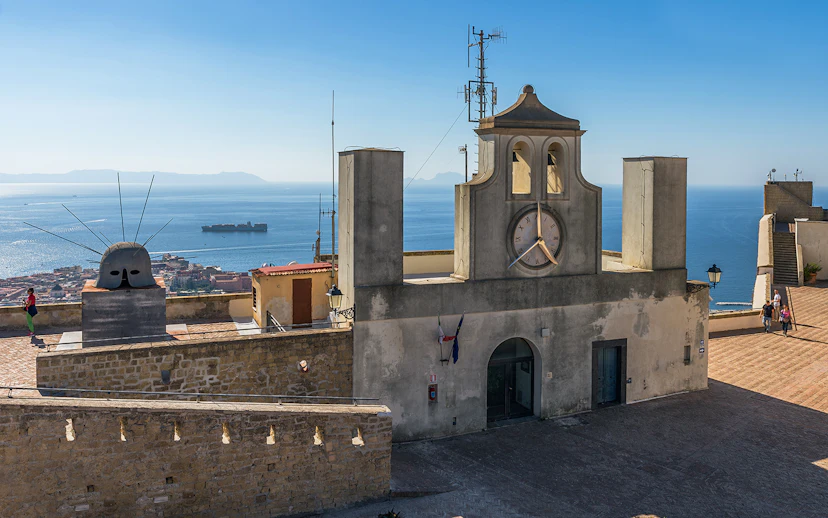
Visiting Castel Sant’Elmo: your complete guide
Castel Sant’Elmo is a hilltop fortress best known for sweeping views over Naples, the bay, and Vesuvius. The visit is more exposed and walk-heavy than many people expect, with broad ramparts, steep approaches, and a modern art museum inside the old military complex. The biggest planning mistake is arriving too late for sunset views and missing the museum galleries that close earlier. This guide helps you time the visit, choose the easiest route up, and avoid missing the parts that shut first.
Quick overview: Castel Sant’Elmo at a glance
If you want the short version before you plan the rest, start here.
- When to visit: Wednesday–Monday, 8:30am–7:30pm. Weekday mornings from 9am–11am are noticeably calmer than weekends and first-Sunday free-entry periods, and the exposed ramparts are far more comfortable before the midday sun gets harsh.
- Getting in: From €6 for standard entry. Guided tours generally start around €30. Booking ahead matters most on holidays, long weekends, and free-entry days, but on an ordinary weekday you can usually stay flexible.
- How long to allow: 2–3 hours for most visitors. It stretches closer to 3 hours if you want terrace time, museum galleries, and a slower perimeter walk around the bastions.
- What most people miss: The Museo del Novecento, the preserved prison areas, and the smaller architectural details around Piazza d’Armi get skipped by visitors who come only for the viewpoint.
- Is a guide worth it? Yes, if you want the fortress’s political history and military design to make sense; if you mainly want the views and museum at your own pace, a good audio guide is usually enough.
Jump to what you need
🕒 Where and when to go
🗓️ How much time do you need?
🎟️ Which ticket is right for you?
🗺️ Getting around
🏰 What to see
♿ Facilities and accessibility
Where and when to go
How do you get to Castel Sant’Elmo?
Castel Sant’Elmo sits on Vomero hill above central Naples, closest to the funicular and Vomero transit links rather than the historic center on foot.
Via Tito Angelini, 20/A, 80129 Naples, Italy
- Funicular: Montesanto Funicular → Morghen station → 8–10 min uphill walk → the easiest way to avoid the long climb from the old town.
- Metro: Line 1 → Vanvitelli station → 15 min walk → manageable if you don’t mind a final uphill stretch.
- Taxi / rideshare: Drop-off near the upper access road → short walk to the entrance → the simplest option in summer heat or if you’re short on time.
Which entrance should you use?
There is one main public entrance, and the mistake most visitors make is assuming a late arrival still gives them enough time for both the fortress and the museum inside.
- Main entrance: Located off Via Tito Angelini. Expect 5–15 min waits on ordinary weekdays and up to 20–30 min on holidays, free Sundays, and sunset-heavy weekends.
When is Castel Sant’Elmo open?
- Wednesday–Monday: 8:30am–7:30pm
- Tuesday: Closed
- Museum galleries: Often close earlier than the fortress itself
- Last entry: Plan to arrive well before 6:30pm if you want both views and museum access
When is it busiest? Weekends, public holidays, first-Sunday free-entry days, and late-afternoon sunset windows are the busiest, with longer entry lines and more crowded terraces.
When should you actually go? Aim for a weekday morning if you want cooler ramparts, cleaner photo light, and enough time to see the museum before its earlier closing window catches you out.
Which Castel Sant’Elmo ticket is best for you
| Ticket type | What's included | Best for | Price range |
|---|---|---|---|
Standard admission ticket | Fortress entry + Museo del Novecento entry | A flexible self-guided visit where you want the views, architecture, and museum without committing to a fixed schedule | From €6 |
Skip-the-line ticket with audio guide | Priority entry + fortress entry + museum entry + multilingual audio guide | A busy-day visit where you want to avoid holiday queues and still understand the site without joining a tour | From €18 |
Guided Castel Sant’Elmo and Certosa di San Martino tour | Fortress entry + Certosa di San Martino entry + licensed guide | A first visit where you want the hilltop history explained clearly and don’t want to piece together the two sites alone | From €30 |
Campania Artecard | Entry to Castel Sant’Elmo + access to multiple Naples and Campania sites + transit benefits | A packed Naples itinerary where you’re combining Sant’Elmo with several museums or archaeological sites over 2–3 days | From €30 |
Sunset photo experience | Fortress entry + guided photo-focused visit timed for late light | A short, view-led visit where timing and skyline photography matter more than covering every museum room | From €90 |
How do you get around Castel Sant’Elmo?
How do you get around Castel Sant’Elmo?
Castel Sant’Elmo is best explored on foot and usually takes 2–3 hours if you cover the ramparts, museum, and inner courtyard properly. The main panoramic terraces sit around the outer edge of the fortress, while the museum spaces and courtyard unfold further inside.
- Panoramic ramparts: Full perimeter views over Naples, the bay, and Vesuvius → allow 20–30 min if you want photo stops at more than one bastion.
- Piazza d’Armi: The central parade ground, main gate, and church of Sant’Erasmo → allow 10–15 min.
- Museo del Novecento: The modern art collection inside the fortress rooms → allow 45–60 min.
- Prison and military rooms: Smaller historic spaces that explain the fortress’s later use as a prison → allow 15–20 min.
Suggested route: Start with the museum while it is definitely open, then move to Piazza d’Armi, and save the ramparts for last so you can slow down at the terraces without worrying about indoor closing times.
Maps and navigation tools
- Map: On-site panels and printed visitor material cover the main zones → pick one up at the entrance before you start the perimeter walk.
- Signage: Wayfinding is good enough for a self-guided visit, but the museum-first route is not always obvious unless you decide on it early.
- Audio guide / app: Multilingual audio options are the best add-on if you want context on the fortress history without joining a scheduled group.
- Large outdoor POIs only: Not applicable.
💡 Pro tip: Walk the museum first and the ramparts second — the views stay put, but the indoor galleries are the part most visitors lose by arriving late.
Get the Castel Sant’Elmo map / audio guide
What can you see from Castel Sant’Elmo?

Panoramic ramparts
Attribute — Viewpoint type: 360-degree fortress terrace
The ramparts are the reason most people come, and they deliver the widest urban panorama in Naples — old center, bay, Vesuvius, and islands all open up from one circuit. What many visitors miss is that each bastion frames the city differently, so it’s worth walking the full edge rather than stopping at the first obvious photo point.
Where to find it: Along the outer perimeter walk immediately beyond the main internal access areas
Bay of Naples and Vesuvius
Attribute — View type: Landmark skyline
This is the classic Sant’Elmo sightline: the curve of the bay with Vesuvius anchoring the horizon. Most people take one quick photo and move on, but the better view comes when you pause long enough to let the scale of the city below separate into districts, port, and coastline.
Where to find it: South- and south-east-facing terrace points along the ramparts
Museo del Novecento
Attribute — Collection focus: 20th-century Italian art
Inside the fortress, the Museo del Novecento shifts the visit from scenery to culture, with works tied to Futurism, Divisionism, and later 20th-century Italian movements. Visitors rushing for the sunset often skip it entirely, which is a mistake — the contrast between the old military shell and modern art is one of the site’s most distinctive qualities.
Where to find it: In the interior museum rooms off the main circulation route inside the fortress
Piazza d’Armi
Attribute — Historic space: Inner parade ground
The central courtyard gives you the fortress stripped back to function: heavy walls, open space, military scale, and the small church of Sant’Erasmo tucked within it. What many people rush past here is the main access architecture and the feeling of how controlled this inner core would once have been.
Where to find it: At the heart of the fortress complex after the main entry sequence
Star-shaped bastions
Attribute — Architectural type: 16th-century military design
Castel Sant’Elmo’s six-pointed star plan is more than a shape seen on a map — it explains how the fort was engineered for defense across difficult hilltop terrain. Most visitors notice the views first and the geometry second, but the angled bastions are what make the panorama feel so unusually open in every direction.
Where to find it: Best understood by walking the perimeter and stopping at the outer points of the ramparts
Prison and military rooms
Attribute — Historic use: Fortress prison spaces
These rooms add a darker layer to the visit, showing Sant’Elmo not just as a lookout but as a site of confinement and political control. They are easy to miss because the terraces dominate the route, but they give the fortress its human weight and make the later cultural reuse feel more meaningful.
Where to find it: In the interior sections branching off the main visitor route
Facilities and accessibility
- 🚻 Restrooms: Basic restrooms are available on-site, but they’re functional rather than polished, so it’s better not to leave this until the very end of your visit.
- 🪑 Seating / rest areas: The inner courtyard and terrace edges give you space to pause, but this is not a heavily seated museum-style visit.
- 📚 Library and archives: The Bruno Molajoli library and photo archive are worth asking about if you’re visiting for Naples history rather than views alone.
- ℹ️ Information panels: Multilingual signs across the fortress help if you’re visiting without a guide and want more than just the panorama.
- ♿ Mobility: Accessibility is partial rather than full, because the hilltop approach, steep ramps, and some internal passages can be difficult even though the main open areas are easier to manage once you are inside.
- 👁️ Visual impairments: Clear on-site panels help with orientation, but the outdoor edges and uneven historic layout mean independent navigation is easier with a companion or audio support.
- 🧠 Cognitive and sensory needs: Weekday mornings are the least overwhelming time to visit, while midday heat and sunset crowding make the exposed ramparts feel much more intense.
- 👨👩👧 Families and strollers: Strollers are possible only in parts and become awkward on steeper sections, so a carrier is often the easier option for very young children.
Castel Sant’Elmo works best for school-age children who like open space, big views, and a bit of fortress drama more than a hands-on museum format.
- 🕐 Time: Around 90 minutes–2 hours is realistic with children, especially if you focus on the ramparts first and keep the museum portion selective.
- 🏠 Facilities: The open courtyard gives kids room to reset between indoor rooms and exposed terrace stretches.
- 💡 Engagement: Turn the star-shaped plan into a game and let children spot Vesuvius, the port, and the old city from different bastions.
- 🎒 Logistics: Bring water, a hat, and sun protection, because the exposed walkways feel much hotter than street level in summer.
- 📍 After your visit: Certosa di San Martino is the easiest follow-on stop because it is only a short walk away and keeps the outing on the same hilltop.
Rules and restrictions
What you need to know before you go
- Entry requirement: Standard entry covers both the fortress and the Museo del Novecento, and online booking is the safer choice on holidays and free-entry Sundays.
- Bag policy: Travel light, because larger bags slow security and make the rampart walk more annoying than it needs to be.
- Re-entry policy: Re-entry is generally not permitted, so don’t leave for lunch or a break unless you’re done with the site.
Not allowed
- 🚫 Food and drink: Keep food and open drinks for outside the exhibition areas so you’re not forced to cut the museum short.
- 🚬 Smoking / vaping: Smoking and vaping belong outside the enclosed museum spaces, not in the historic interiors.
- 🐾 Pets: Service animals are the safer assumption to plan around; if you’re traveling with a pet, check policy before you make the climb.
- 🖐️ Touching exhibits / climbing: Don’t climb on walls or parapets, and don’t touch artworks or historic surfaces, because this is still both a fortress and a museum site.
Photography
Photography is usually the easiest part of the visit on the ramparts, terraces, and courtyard, where the views are the whole point. Inside the Museo del Novecento and temporary exhibition rooms, rules can vary by gallery, so check the posted notices rather than assuming the terrace policy applies everywhere. Flash, tripods, and selfie sticks are the items most likely to be restricted indoors.
Good to know
- Museum timing: The museum spaces can close earlier than the fortress, so a late arrival may still get you the views but not the full indoor visit.
- Heat exposure: The ramparts are far more exposed than they look in photos, and midday summer visits can feel punishing without shade, water, and sun protection.
Practical tips
- Booking and arrival: Book ahead for weekends, public holidays, and first-Sunday free-entry days, because those are the moments when this low-cost site suddenly behaves like a high-demand viewpoint.
- Pacing: Do the Museo del Novecento first, because it is the only part of the visit that can effectively disappear on you if you arrive too late in the day.
- Crowd management: The sweet spot is a weekday visit around 9:30am–11am, when the terraces are quieter, the light is still good for photos, and the exposed stone hasn’t started radiating full afternoon heat.
- What to bring or leave behind: Bring water, sunglasses, and a hat in warm months, but leave bulky bags behind because the uphill approach and open ramparts make extra weight feel much worse here than at a compact indoor museum.
- Food and drink: Eat before you enter or plan a proper stop after the visit in Vomero, because Sant’Elmo is better for views than for lingering over food and re-entry is not something to count on.
- Pairing nearby sites: If you also want Certosa di San Martino, do both back-to-back on the same hilltop rather than coming up twice — the 5-min walk between them is one of the easiest same-area pairings in Naples.
What else is worth visiting nearby?
Commonly Paired: Certosa di San Martino
Distance: 350 m – 5 min walk
Why people combine them: They share the same hilltop setting, so you get two of Naples’ strongest panoramic and historical sites without wasting time on extra transit.
✨ Castel Sant’Elmo and Certosa di San Martino are most commonly visited together — and simplest to do on a combined guided outing. The practical advantage is that you stay on one route across Vomero instead of making two separate climbs.
Commonly Paired: Naples historic center
Distance: About 20 min by funicular and walk
Why people combine them: Sant’Elmo gives you the big-picture skyline first, then the historic center lets you drop back into the dense street-level Naples you were just looking at from above.
Also nearby
Via Scarlatti and Via Luca Giordano
Distance: About 10–15 min walk
Worth knowing: These Vomero shopping streets are the easiest place to decompress after the fortress with coffee, food, and everyday neighborhood Naples rather than another major monument.
Castel Nuovo
Distance: About 25 min by funicular and walk
Worth knowing: If Sant’Elmo gives you Naples from above, Castel Nuovo gives you the city’s fortress history back at street level and pairs well if you’re comparing the city’s castles.
Eat, shop and stay near Castel Sant’Elmo
- On-site: Food options are limited once you’re inside the fortress, so this is better treated as a sightseeing stop than a meal stop.
- Via Scarlatti cafés: 10–15 min walk, Vomero; coffee bars and light bites that work well before a morning visit or after the downhill walk back from the castle.
- Vomero trattorias near Piazza Vanvitelli: 15 min walk, Vomero; a better choice if you want a proper sit-down meal after the ramparts rather than a quick snack.
- San Martino / Morghen area bars: 8–12 min walk, Vomero; useful for a drink with a view-adjacent atmosphere without heading all the way back to the historic center.
- 💡 Pro tip: Eat before a sunset visit, not after — by the time you come down from the fortress, the best light is gone and the uphill return is no longer worth it.
- Via Scarlatti: The most practical nearby shopping stretch for everyday browsing, local specialty food stops, and a post-visit coffee break.
- Via Luca Giordano: A longer retail street in Vomero that makes more sense than hunting for shopping right outside the fortress gates.
Vomero is convenient, calm, and walkable for a short Naples stay if you value space, cleaner pacing, and easy access to Castel Sant’Elmo and Certosa di San Martino. It feels more residential than atmospheric after dark compared with the historic center, so it suits travelers who want a quieter base more than those chasing the classic Naples street scene.
- Price point: Mostly mid-range to upper-mid-range, with fewer true budget stays than the historic center.
- Best for: Short trips where you want easy hilltop access, calmer evenings, and less day-to-day noise.
- Consider instead: Stay in the historic center or around Chiaia if you want denser sightseeing, stronger restaurant choice, and a more classic Naples first-time base.
Frequently asked questions about visiting Castel Sant’Elmo
Most visits take 2–3 hours. That is enough time for the ramparts, the main courtyard, and the Museo del Novecento without rushing. If you come mainly for the panorama, you can do it in about 90 minutes, but pairing it with Certosa di San Martino usually turns it into a half-day.
No, you do not always need to book in advance, but it is the safer move on weekends, public holidays, and first-Sunday free-entry days. On a normal weekday, flexibility is usually fine. If timing matters to you because you also want the museum, booking ahead removes one more thing that can slow the visit down.
Yes, skip-the-line is worth it on holidays, long weekends, and free-entry Sundays, but less necessary on ordinary weekdays. This is not a Vatican-level queue situation every day, yet a 20–30 min wait at the gate feels longer when you are standing in full sun on a hilltop visit you chose partly for the views.
Arrive about 15 minutes early. That gives you enough buffer for ticket checks and helps if you want to start with the museum before heading outside. If you are aiming for a late-day visit, earlier is better, because the indoor galleries can close before the fortress itself.
Yes, a small bag or backpack is usually manageable, but traveling light is the better choice here. The uphill access and exposed ramparts make bulky bags more irritating than they would be at a compact indoor museum. If you are carrying valuables, keep them close because much of the visit is outdoors.
Yes, photography is one of the main reasons to visit, especially on the terraces and ramparts. The only caution is indoors, where temporary exhibitions and museum rooms may have their own posted rules. Flash, tripods, and selfie sticks are the most likely items to be restricted.
Yes, Castel Sant’Elmo works well for groups, especially if you want a guided visit that explains the military design and political history. The open layout helps groups spread out more easily than in a compact museum, but a guide adds the most value if you are also pairing it with Certosa di San Martino.
Yes, it can be a good family stop, especially for children who enjoy wide-open spaces and big views. The ramparts and star-shaped plan are more engaging for many kids than the museum rooms, so a 90-minute to 2-hour visit is usually the right family pace unless your children already like art museums.
Accessibility is partial rather than full. The hilltop location, steep approaches, and some historic passages can be difficult, even though the main open areas are more manageable once you are inside. If mobility is a concern, reaching Vomero by taxi or funicular is much easier than attempting the climb from the old town.
Food is easier to find near Castel Sant’Elmo than inside it. The best plan is usually to eat before you enter or head back into Vomero afterward, where cafés and restaurants are a 10–15 min walk away. Because re-entry is not something to rely on, treat food as a before-or-after decision.
Late afternoon has the best light for skyline photos, but weekday mornings are better if you want the fullest visit. Morning gives you cooler ramparts, fewer people, and enough time for the museum before indoor closing times become an issue. Sunset is stronger for atmosphere, but weaker for a complete visit.
Yes, Castel Sant’Elmo is worth it if you want a view-led Naples stop that also has real historical substance. It is less overwhelming than Pompeii and less crowded than some city-center landmarks, but it still gives you strong context for the city. The biggest reason to go is that nowhere else in Naples combines this kind of panorama with a fortress walk and modern art museum in one stop.